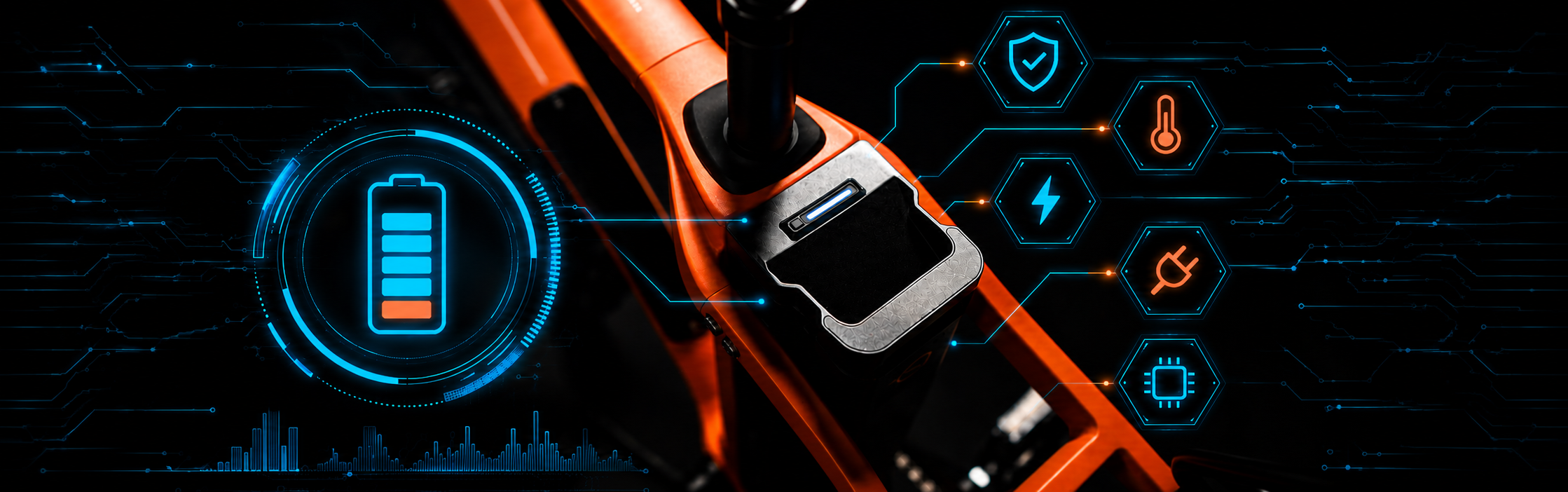
When people look at an eBike, the first question is almost always about range. "How far can it go on one charge?" That is a fair question. But here is the one that matters more: what is inside the battery, and can you trust it?
At NINE09, we are building smart eBikes for city riders. Understanding your battery makes you a smarter buyer and a happier rider. So let us walk through all of it in plain language.
What Is an eBike Battery
An eBike battery is the primary power source of an electric bicycle. It stores electrical energy and supplies it to the motor, enabling pedal assistance that makes riding smoother, easier, and more efficient. Most modern electric bikes use lithium-ion (Li-ion) batteries because they are lightweight, energy-dense, and built to deliver reliable performance over many charge cycles.
How an eBike Battery Works?
Think of the battery as the fuel tank of your eBike. When you pedal or activate pedal assist, it delivers stored electrical energy to the motor, providing extra power to make your ride easier and more enjoyable.
Modern eBike battery technology is built around lithium-ion (Li-ion) cells, the same advanced technology used in laptops and smartphones. Li-ion batteries are popular because they are lightweight, energy-efficient, and designed to deliver reliable performance and a long service life when properly maintained.
Under the EN 15194 standard, which is the main safety standard for eBikes sold in the EU market, a legal eBike motor can deliver a maximum of 250W and must stop helping you once you reach 25 km/h. The battery powers that motor within those limits.
The EU Battery Regulation 2023/1542 officially classifies eBike batteries as Light Means of Transport (LMT) batteries. This classification gives riders new legal rights and protections coming into force between now and 2030.
Understanding Battery Capacity: Why Watt-Hours Matter
You do not need to be an engineer to understand these. Here is what each one means.
Watt-hours (Wh) is the most important number. It tells you how much energy the battery holds. A 374Wh battery can deliver 374 watts of power for one full hour. The higher the Wh, the more range you get. When comparing eBikes, always check this number first.
Voltage (V) is basically the strength of the electrical push. Most eBikes run on 36V. Higher voltage usually means better performance.
Amp-hours (Ah) is the capacity of the battery in current terms. If you multiply Ah by the voltage, you get the Wh figure. So 10.4Ah at 36V gives you 374Wh.
BMS (Battery Management System) is the smart brain inside the battery. It keeps every cell safe and healthy. There is a full section on this below because it really matters.
Cycle life is how many times you can fully charge and discharge the battery before it starts losing noticeable capacity. A good Li-ion battery handles 500 to 1,000 cycles, which is roughly two to five years of daily use.
CE marking is the mandatory safety mark for any battery sold in the EU. It confirms the product has been checked against official safety and performance requirements. Always look for this before you buy.
New EU Battery Rules: What Riders Need to Know
Most people have not heard about this yet, but it is a big deal.
The EU Battery Regulation 2023/1542 came into force on 18 February 2024 and rolls out in stages. Here are the three moments that matter most for everyday eBike riders.
From 2026, brands must be registered in official producer responsibility systems. This means they are legally responsible for what happens to your battery at the end of its life, including collection and recycling.
From 18 February 2027, every eBike battery must carry a Digital Battery Passport. This is a QR code on the battery that anyone can scan to see who made it, when it was made, what materials are inside it, and how it has been rated for performance and durability. Buying a used eBike will become much more transparent because of this.
Also from February 2027, under Article 11 of the regulation, all eBike batteries must be designed so that riders or repair shops can remove and replace them. Sealed batteries that cannot be taken out will no longer be allowed for new eBikes placed on the market.
This is a big shift. Many brands have built eBikes with batteries permanently locked into the frame. Those designs will need to change. NINE09 already solved this problem before the regulation was even finalised.
NINE09's 374Wh battery is fully swappable right now. Not because a rule forced us to do it. Because we believed from day one that riders deserve that freedom.
What Affects eBike Range? 6 Factors Every Rider Should Know
The "up to 99 km" figure on the NINE09 CX01 and CX02 is genuine. But range changes depending on how and where you ride. Here is what shapes it.
Assist level matters a lot. Both the CX01 and CX02 offer several pedal-assist modes. In Eco mode, the motor uses very little power, and your range stretches much further. In Sport or Turbo mode, you get more help, but the battery drains faster.
Hills are the biggest drain on any battery. Climbing a steep road can use three to five times more power compared to flat riding. Hilly cities will give you noticeably less range than flat ones.
Cold weather reduces what your battery can deliver. At 5 degrees Celsius, a Li-ion battery may give you 15 to 20 percent less range compared to riding at 20 degrees. This is a chemical fact, not a design flaw.
Wind adds resistance. Riding into a headwind at 25 km/h uses more motor power than riding in calm conditions. Coastal cities and open routes feel this more than sheltered streets.
Rider weight and cargo increase how hard the motor works. A heavier load means the battery drains faster, especially on hills.
Tyre pressure is easy to overlook. Under-inflated tyres create more friction against the road. Keeping tyres at the right pressure is a simple free way to protect your range.
Smart BMS: The Safety Brain Inside Your Battery
The Battery Management System is the single most important thing inside your battery. It is what keeps you safe and keeps the battery healthy for years.
Here is what a good BMS does all the time, without you ever seeing it.
Cell balancing makes sure every cell in the battery charges and drains at the same rate. When cells get out of balance, some age faster than others and the whole battery dies early.
Overcharge protection stops the battery from going above its maximum safe voltage during charging. Overcharging causes heat, which damages cells and creates safety risks.
Over-discharge protection cuts the power before the cells drop too low. Running cells completely flat causes permanent damage.
Short-circuit protection instantly breaks the circuit if something goes wrong electrically.
Temperature management watches the temperature of the cells constantly. If they get too cold or too hot, the BMS slows down or stops charging and discharging to protect them.
State of Charge reporting gives you the accurate battery percentage you see on your display. A good BMS tells you the truth so you can plan your ride properly.
NINE09's Smart BMS does all of the above and goes a step further. It tracks battery health over time, not just in the moment. This means the percentage you see on the 4.3-inch LCD touchscreen is genuinely accurate, and the battery ages gradually rather than degrading fast.
Why a Swappable Battery Is a Smarter Choice
Most eBike batteries are sealed inside the frame. You can only charge them by plugging a cable into the bike itself. This sounds simple until you realise the problems it creates.
If you park your bike in a basement or outdoor shed with no power socket nearby, you cannot charge it. If you live in a flat without a garage, you have to drag your whole bike inside just to charge it. If you want to extend your range on a long day out, there is no option at all.
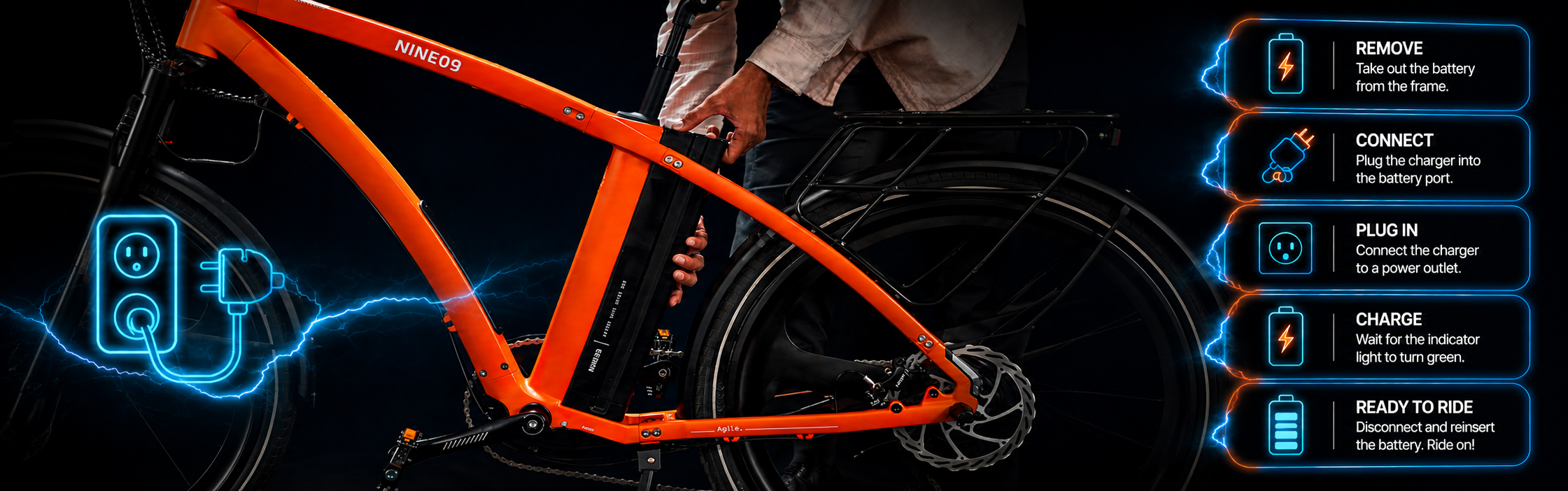
NINE09's battery slots out in seconds. You carry it with you like a bag. You plug it into any standard home socket. You charge it in your kitchen, at your office, or at a friend's place. The bike does not need to be anywhere near a power point.
This matters for three specific reasons.
Charging in your flat is now easy. A huge number of city dwellers have no dedicated bike storage close to electricity. With a swappable battery, you take it upstairs and charge it like you would a laptop.
Your battery lasts longer. Charging at indoor room temperature is much better for Li-ion cells than charging in cold or hot outdoor conditions. A sealed battery left in a parked bike through a freezing night is being quietly damaged.
You are future-ready. From 2027 the EU Battery Regulation requires eBike batteries to be removable and replaceable. NINE09 already meets this requirement. The CX01 and CX02 you buy today will not be made obsolete by incoming rules.
NINE09's 374Wh Battery: Full Specification Breakdown
Both the CX01 (StepOver frame) and the CX02 (StepThrough frame) use the same battery, so if you own both you can swap between them freely.
- 374Wh capacity gives you up to 99 km of real-world range on a single charge. That covers almost any daily commute without needing to top up during the day.
- IPX7 water protection means the battery can survive being submerged in one metre of water for 30 minutes. Most eBike batteries carry IPX5, which handles water jets but not submersion. In cities where heavy rain is just a normal Tuesday, the difference is real.
- Smart BMS with active health monitoring includes built-in short-circuit protection and over and under temperature protection as standard. It feeds real-time data to the display and the NINE09 app at all times.
- CE marking and EN 15194 alignment confirms that the CX01 and CX02 are legal, road-ready EPAC bicycles: 250W motor, 25 km/h assisted speed, pedal-assist operation throughout.
- Remote battery unlock via the NINE09 app means the battery is electronically locked to your phone. A stranger cannot simply pull it out and walk away. You unlock it remotely before you remove it.
- Full integration with the NINE09 platform means battery charge level, health data, and energy use all show up live in the app alongside GPS location, turn-by-turn navigation, call control from the handlebars, and multi-user profile management.
5 Simple Habits to Extend Battery Life
Good habits make a big difference to how long your battery lasts. These are simple and take almost no effort.
- Charge indoors whenever you can. Cold temperatures stress Li-ion cells during charging. Bringing the battery inside to charge at room temperature is the single best thing you can do for its long-term health.
- Do not store at 0% or 100%. If you are not riding for a few days or longer, keep the battery between 40 and 60 percent charge. Storing fully charged or fully empty both speed up ageing.
- Wait before charging after a long ride. The battery gets warm during hard use. Give it 20 to 30 minutes to cool down before plugging in.
- Use the charger that came with the bike. Third-party chargers may not match the BMS settings exactly. Even small mismatches can shorten battery life over hundreds of charge cycles.
- Bring the battery inside during cold months. The riding itself is fine in cold weather. It is the cold sitting for hours in a parked bike that does the most damage.
NINE09 and the New Battery Rules: Already Compliant
Some eBike buyers now ask brands directly: are you meeting your obligations under the new battery laws, or are you just building products and moving on?
Here is where NINE09 stands.
CE marking is on every battery we place on the market. Our swappable battery architecture already satisfies the 2027 removability requirement under Article 11. The Smart BMS already captures the performance and durability data that will form the basis of the Digital Battery Passport requirement from 2027. And the IPX7 rating meets and exceeds the safety expectations set out for LMT batteries under the regulation.
The new battery rules are not a problem for NINE09. They are confirmation that the choices we made from the start were the right ones.
CX01 vs CX02: Which Frame Suits You?
Both bikes share the same battery, dual suspension, integrated smart rear lighting, 4.3 inch LCD touchscreen, and full NINE09 app connectivity. The difference comes down to the frame.
- The CX01 uses a StepOver frame. This is the classic diamond shape. It suits riders who want a sporty feel and a firm riding position.
- The CX02 uses a StepThrough frame. The lower, open design makes it easy to get on and off, especially in stop-and-start city traffic. It is very popular with commuters and anyone who cycles in work clothes.
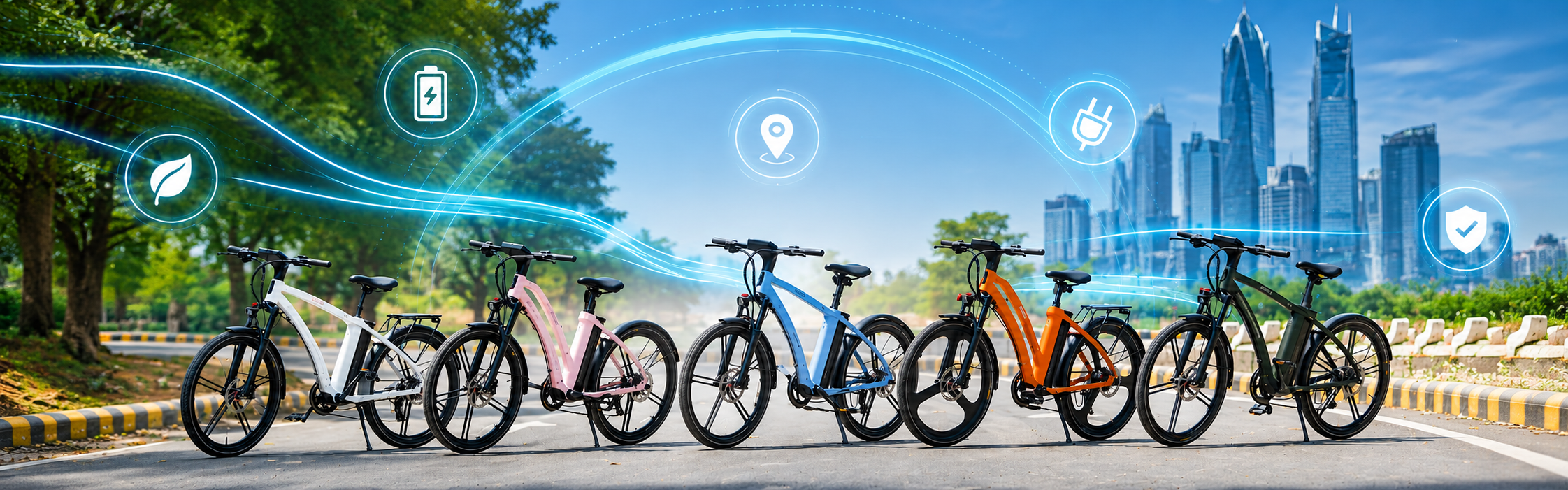
Both are available in five colours.
Final Thoughts
The eBike battery world is changing fast. New laws, smarter buyers, and a growing focus on how long things last and what happens when they do not.
NINE09 built the CX01 and CX02 with all of that in mind from day one. A 374Wh swappable battery with IPX7 protection, a Smart BMS, remote app unlock, and full CE marking under EN 15194. A battery that charges in your flat, swaps in seconds, survives the rain, and already meets the rules every other eBike brand will have to catch up with by 2027.
Explore the CX01 and CX02 at nine09ev.com.
Frequently Asked Questions
What is EN 15194?
It is the main EU safety standard for eBikes. It sets the rules for motor power (max 250W), assisted speed (max 25 km/h), and battery requirements. Any eBike sold in the EU must meet this standard and carry CE marking.
What is the EU Battery Regulation 2023/1542?
A law that governs the full life of a battery, from production to recycling. For eBike riders, the two key changes are a Digital Battery Passport and mandatory removable batteries, both required from February 2027.
Will eBike batteries have to be removable by law?
Yes. From 18 February 2027, all eBike batteries must be removable and replaceable by the rider or a repair shop. Sealed batteries will not be permitted on new eBikes after this date.
Is NINE09's battery already compliant with the 2027 rules?
Yes. Both the CX01 and CX02 have a fully swappable 374Wh battery that comes out without any tools. It already meets the 2027 requirement today.
What does IPX7 mean?
It means the battery can be submerged in one metre of water for 30 minutes without damage. This is a higher level of protection than the IPX5 standard most eBike batteries carry.
Can I charge the battery in my flat?
Yes. Pull the battery out, take it inside, and plug it into any normal home socket. No need for a garage or outdoor power point.
What does a Smart BMS do?
It protects and monitors every cell inside the battery continuously, balancing charge, preventing overcharging and over-discharging, managing temperature, and sending accurate battery percentage data to your display and app.
NINE09 is an eMobility brand committed to redefining urban transportation with smart electric bicycles. Exhibiting at Eurobike Frankfurt 2026.

June 23, 2026 | Advancement & Technology
Top 5 AI-Powered Smart Features on the NINE09 CX01 and CX02
June 20, 2026 | Commuting and Urban riding
How AI Electric Bikes Are Reshaping the Future of Urban Commuting
June 14, 2026 | Battery care & Charging