Most e-bike riders think about charging only when the low-battery warning shows up. That's normal, but how you charge, where you charge, and what charge level you keep day-to-day has a real impact on battery lifespan and safety.
Many quality lithium-ion packs are designed for hundreds of charge cycles (often quoted around 500–1,000 full cycles) when treated well. Treated carelessly, you can see noticeable range loss much sooner.
At NINE09, our CX commuter e-bikes are built around a 374Wh swappable battery with a Smart BMS (Battery Management System), so you can charge more conveniently and monitor battery health more intelligently. Explore NINE09's smart commuter e-bikes to discover connected features, intelligent battery technology, and urban-ready performance designed for everyday riding.
How to charge ebike battery safely (step by step)
Charging is simple, but you'll get better longevity (and fewer problems) if you follow a consistent routine.
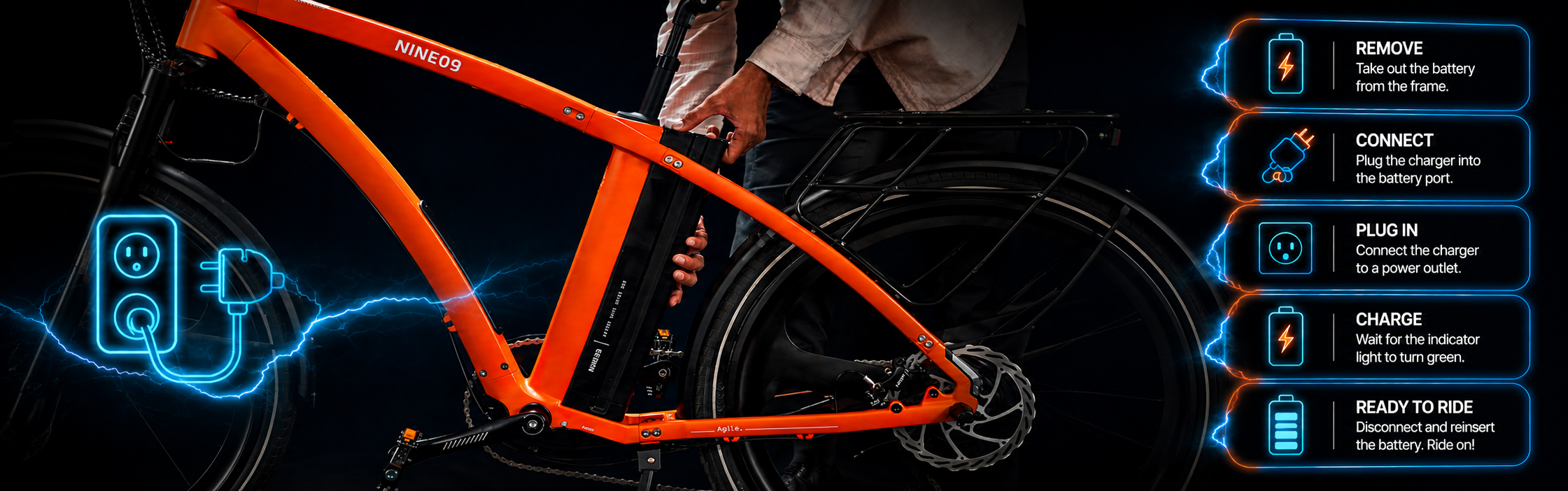
Step 1: Charge the battery on or off the bike (depending on your model)
Some e-bikes are designed to charge on the frame; others have removable/swappable packs.
With NINE09's swappable design, you can remove the battery and charge it indoors, which is often the easiest way to keep charging dry, clean, and at stable room temperature. This convenient feature is available on both the NINE09 CX01 and NINE09 CX02, giving riders greater flexibility for everyday urban commuting.
Step 2: Let the battery return to room temperature
After a long ride, the battery can be warm. In winter, it can be very cold.
A simple rule that works well in Europe's changing seasons:
- If the battery feels hot after a ride, let it cool.
- If it's been outside in cold weather, bring it indoors and let it warm up.
This protects the cells and supports healthier charging.
Step 3: Use only the charger designed for your battery
This is both a performance and a safety issue.
Use the original charger that came with your e-bike (or an official replacement with identical specifications). Using "universal" or cheap replacement chargers can create mismatched voltage/current behaviour over time.
Step 4: Charge in a safe place (especially in flats)
For most European riders, the biggest real-world challenge is charging at home, often in a flat, hallway, shared entrance, or near storage.
Use this apartment-friendly setup:
- Choose a dry, well-ventilated space at around room temperature.
- Place the battery and charger on a hard, flat, non-flammable surface (tile, stone, concrete, or a metal tray).
- Keep it away from curtains, bedding, paper, or clutter.
- Keep cables tidy so nothing can snag or pull the charger.
Step 5: Don't charge unattended or while you're asleep
The safest habit is simple: charge when you're awake and nearby and unplug once charging is complete.
Step 6: Unplug when you reach your target charge
Once you've hit your planned charge level, unplug.
It's a small action that reduces how long your battery sits at "full," and it's also a safer everyday routine.
The 20–80 rule: The simplest habit for longer battery life
For daily commuting, you usually don't need 100%.
Lithium-ion cells experience the most stress at the extremes:
- very high charge (near 100%)
- very low charge (near empty)
For everyday rides, a practical target is:
- charge somewhere in the 20–80% range most days
- charge to 100% only when you genuinely need maximum range
Because NINE09 uses Smart BMS monitoring, your battery percentage is designed to be consistent and useful for day-to-day planning, helping you better manage your rides and battery usage.
NOTE
Some systems benefit from an occasional full charge, so the battery gauge stays accurate. Follow your model's manual for your exact recommendation.
Where to charge: Why swappable batteries are a big deal in Europe
Many riders across Europe store bikes in:
- shared building entrances
- underground parking
- communal bike rooms
- outdoor courtyards
A swappable battery changes the experience: you keep the bike stored where it makes sense, and bring the battery inside to charge.
That's not just convenient, it often means safer charging conditions with a stable temperature, less moisture, and better supervision.
This is one of the key advantages of the swappable battery system used across NINE09 commuter e-bikes.
Temperature and charging (Celsius rules that matter)
Temperature affects both safety and long-term capacity.
Cold weather
Avoid charging a battery that's been sitting outside in near-freezing conditions.
As a practical guideline:
- If the battery was outdoors and it's cold, bring it inside and wait 30–60 minutes before charging.
Summer heat
Avoid charging:
- in direct sun
- inside a hot car
- in a sealed space that traps heat
Let the battery cool first.
Five charging mistakes that shorten battery life
These are the patterns that quietly reduce range over time.
Charging to 100% every day
For regular commuting, the 20–80% habit is gentler.
Leaving the battery at 100% for days
If you're not riding tomorrow, don't keep it stored at full charge.
Using a cheap replacement charger
If you need a replacement, buy from the manufacturer or a reputable seller with the correct specifications.
Charging in a hallway or near an exit
Charging should never block escape routes. Choose a safe spot away from your main route through the home.
Storing at 0% or 100%
For longer storage (holiday travel, winter downtime), aim for 40–60% in a cool, dry indoor place.
How long does it take to charge a NINE09 374Wh battery?
Charge time depends on battery capacity (Wh), charger output (A), and how the charging curve tapers near the top.
As a practical expectation:
- 0–100%: roughly 4–5 hours
- 40–80% top-up: often around 2 hours
Actual charging times may vary based on factors such as battery temperature, charger specifications, and the battery's current state of charge.
What the Smart BMS does during charging
A battery management system works behind the scenes to make charging safer and healthier for the cells.
A Smart BMS typically:
- monitors temperature and current during charging
- protects against over-voltage/under-voltage and short circuits
- helps keep cells balanced so the pack ages more evenly
NINE09's Smart BMS is designed with battery health monitoring and safety protections as part of the commuting experience.
How long should an e-bike battery last?
Battery lifespan depends on:
- how often you charge to 100%
- how often you ride to near-empty
- how much time the battery spends in hot/cold conditions
- how you store it between rides
With daily commuter-friendly habits (20–80% charging, indoor charging, avoiding extremes), most riders can extend usable life significantly.
From a policy and repairability perspective, the EU's Batteries Regulation (EU) 2023/1542 includes requirements around removability and replaceability that apply from 18 February 2027. You can read the regulation text here: Regulation (EU) 2023/1542 (EUR-Lex).
NINE09's approach is already aligned with long-term ownership through a swappable battery design and repair-friendly thinking.
Final thoughts
Charging is easy. Charging well is a habit.
Keep it dry, keep it cool, use the correct charger, avoid charging unattended, and stay in the 20–80% zone for most days. That's how you protect battery health and keep your commute smooth.
If you want help choosing the right NINE09 model for your commute, explore the NINE09 commuter lineup or contact our NINE09 team.
For more commuting tips and updates, visit the NINE09 news and city riding stories.
Frequently asked questions
Can I charge my e-bike battery every day?
Yes. Daily charging is fine. For longer battery life, avoid making 100% your default unless you need full range.
Is it safe to charge an e-bike battery overnight?
Best practice is to avoid charging while you're asleep. Charge when you're awake and nearby, then unplug when complete.
Can I charge in wet weather?
Ride ratings (like IPX water resistance) are not the same as charging conditions. Always charge in a dry, indoor, ventilated area.
Should I fully discharge before charging?
No. Lithium-ion batteries don't need full discharge. Regular top-ups are normal.
How do I store the battery over winter?
Store indoors in a dry place at 40–60% charge. Check it every few weeks and top up if needed.

June 23, 2026 | Advancement & Technology
Top 5 AI-Powered Smart Features on the NINE09 CX01 and CX02
June 20, 2026 | Commuting and Urban riding
How AI Electric Bikes Are Reshaping the Future of Urban Commuting
June 17, 2026 | Battery care & Charging